

-
 Media gallery

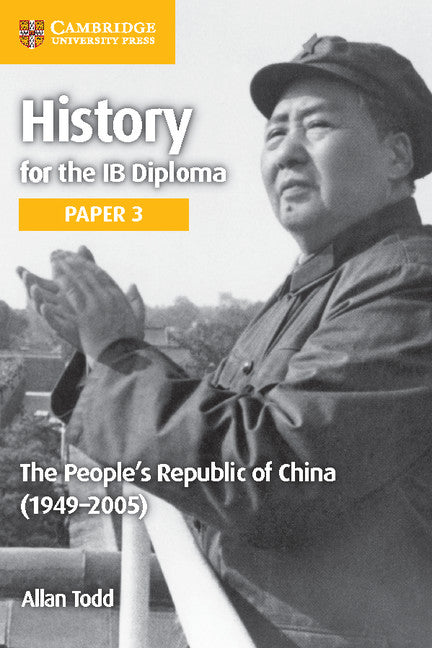
History for the IB Diploma Paper 3: The People's Republic of China (1949–2005)
- Sale price
- Rs. 2,280.00
- Regular price
-
Rs. 2,699.00 - Regular price
- Rs. 2,280.00
- Unit price
- per
(MRP is inclusive of all taxes)
Comprehensive books to support study of History for the IB Diploma Paper 3, revised for first assessment in 2017.
Guaranteed safe checkout
Couldn't load pickup availability
Details
Details
This History for the IB Diploma Paper 3 The People’s Republic of China (1949-2005) coursebook covers Paper 3, HL option 3: History of Asia and Oceania, Topic 14: The People’s Republic of China (1949-2005) of the History for the International Baccalaureate (IB) Diploma syllabus for first assessment in 2017. Tailored to the requirements of the IB syllabus, and written by an experienced examiner and teacher it offers an authoritative and engaging guidance through China during the rule of the Chinese Communist Party, the changes experienced under Chairman Mao Zedong and the modernisation of the country’s economy. This History for the IB Diploma Paper 3 coursebook offers activities throughout the chapters to encourage an exploratory and inquiring approach to historical learning, a wide range of primary and secondary sources to inspire engagement with multiple historical perspectives and interpretations, and develop students’ analytical skills. It also offers links to Theory of Knowledge to stimulate reflective discussion and Paper 3 exam-style questions to help improve student performance and provide preparation for assessment.
Features
- Authoritative and comprehensive text, written by experienced IB History examiners, covering one topic per title, to help students adopt an investigative and thorough approach to their study.
- Activities throughout the chapters to encourage an exploratory and inquiring approach to historical learning.
- A wide range of primary and secondary sources to develop students’ analytical skills.
- Opportunities for balanced historical debate to inspire engagement with multiple historical perspectives and interpretations.
- Links to Theory of Knowledge concepts to stimulate reflective discussion.
- Paper 3 exam-style questions to help improve student performance and provide preparation for assessment.
Contents
- 1. Introduction
- Chapter 2. The consolidation of the communist state, 1949-55:
- 2.1. How did the Communists establish their political rule in the years 1949-55?
- 2.2. What were the main economic policies during the period 1949-55?
- 2.3. What social reforms did the Communists implement during the years 1949-55?
- Chapter 3. Mao's Revolution, 1956-61:
- 3.1. Why was the Hundred Flowers' Campaign launched?
- 3.2. What were the main features of the 'Great Leap Forward'?
- 3.3. What were the immediate consequences of the 'Great Leap Forward'?
- Chapter 4. Power Struggles and the Cultural Revolution, 1962-71: 4.1. How did Mao begin to re-establish his political leadership after 1961?
- 4.2. What were the main features of the Cultural Revolution?
- 4.3. Why was there a new power struggle during 1970-71?
- Chapter 5. Foreign policy, 1949-1976:
- 5.1. What were the main features of Communist China's early foreign policy?
- 5.2. Why did a serious rift develop between China and the Soviet Union in the 1960s?
- 5.3. What was the significance of Communist China's rapprochement with the USA in the 1970s?
- Chapter 6. The struggle for power, 1972-82:
- 6.1. Why were there tensions within the CCP from 1972-75?
- 6.2. What was Mao's legacy?
- 6.3. What were the main stages of the power struggle 1976–82?
- Chapter 7. Deng's Economic Revolution (1976-1989):
- 7.1. What economic policies were followed by Hua in the period 1976–78?
- 7.2. What were the main features of Deng's 'Revolution', 1979–89?
- 7.3. How successful were Deng's economic reforms?
- Chapter 8. Political Developments under Deng, 1976-89:
- 8.1. What was Deng's political approach in the period 1976–79?
- 8.2. Why did political unrest re-emerge in the period 1980–87?
- 8.3. What led to the Tiananmen Square Massacre of June 1989?
- Chapter 9. Developments in China, 1989-2005:
- 9.1. How did China's politics change after 1989?
- 9.2. What were the main economic developments after 1989?
- 9.3. How far have China's leaders created a 'Harmonious Society'?
- 9.4. How did China's relations with the rest of the world develop after 1989?
- 9.5. To what extent was China still communist by 2005?
- Chapter 10. Exam practice
- Further Reading
- Index.
Notified by email when this product becomes available
