

-
 Media gallery

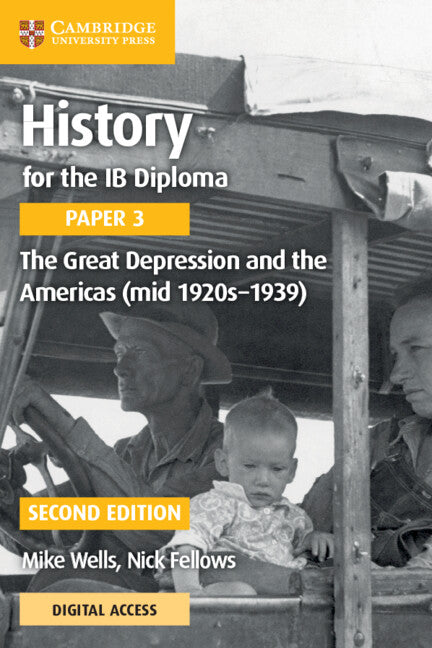
History for the IB Diploma Paper 3: The Great Depression and the Americas (mid 1920s–1939) Coursebook with Digital Access (2 years)
- Sale price
- Rs. 2,850.00
- Regular price
-
- Regular price
- Rs. 2,850.00
- Unit price
- per
(MRP is inclusive of all taxes)
Comprehensive books to support study of History for the IB Diploma Paper 3, revised for first assessment in 2017.
Guaranteed safe checkout
Couldn't load pickup availability
Details
Details
This History for the IB Diploma Paper 3 The Great Depression and the Americas (mid-1920s-1939) (second edition) coursebook covers Paper 3, HL option 2: History of the Americas, Topic 12: The Great Depression and the Americas (mid 1920s-1939) of the History for the International Baccalaureate (IB) Diploma syllabus for first assessment in 2017. Tailored to the requirements of the IB syllabus, and written by experienced examiners and teachers it offers an authoritative and engaging guidance through the causes of the Great Depression, the various ways in which governments attempted to solve the crisis and the impact on the region. This History for the IB Diploma Paper 3 coursebook offers activities throughout the chapters to encourage an exploratory and inquiring approach to historical learning, a wide range of primary and secondary sources to inspire engagement with multiple historical perspectives and interpretations, and develop students’ analytical skills. It also offers links to Theory of Knowledge to stimulate reflective discussion and Paper 3 exam-style questions to help improve student performance and provide preparation for assessment.
Features
- Authoritative and comprehensive text, written by experienced IB History examiners, covering one topic per title, to help students adopt an investigative and thorough approach to their study.
- Activities throughout the chapters to encourage an exploratory and inquiring approach to historical learning.
- A wide range of primary and secondary sources to develop students’ analytical skills.
- Opportunities for balanced historical debate to inspire engagement with multiple historical perspectives and interpretations.
- Links to Theory of Knowledge concepts to stimulate reflective discussion.
- Key Concept links to highlight how the 6 new key concepts can be integrated into the course.
Contents
- Chapter 1. Introduction
- Chapter 2. Political and economic causes of the Great Depression in the Americas:
- 2.1. What were the political and economic causes of the Great Depression in the US?
- 2.2. What was the Wall Street Crash and why was it so important?
- 2.3. Who was most responsible for the Great Depression?
- 2.4. What were the political and economic causes of the Great Depression in Latin America?
- 2.5. What were the political and economic causes of the Great Depression in Canada? Chapter 3. The US and the First New Deal:
- 3.1. What was the impact of the Great Depression on the United States?
- 3.2. How effectively did Hoover deal with the problems caused by the Depression?
- 3.3. How effective was the first New Deal in solving the problems caused by the Depression?
- 3.4. What was the significance of the first One Hundred Days?
- Chapter 4. Opposition, criticism and the Second and Third New Deals: 4.1. Why was there opposition to the New Deals?
- 4.2. Who opposed the New Deals?
- 4.3. Did the New Deal benefit everyone?
- 4.4. What was the impact of the criticism?
- 4.5. How successful were the Second New Deal?
- 4.6. Was there a Third New Deal?
- Chapter 5. The nature and efficacy of solutions in Canada: the ministries of Mackenzie King and R. B. Bennett 1929-39:
- 5.1. What was the impact of the Great Depression on Canada?
- 5.2. Why did Mackenzie King and the Liberals lose the 1930 election?
- 5.3. How successfully did the Conservative government of R. B. Bennett deal with the problems caused by the Depression?
- 5.4. How successfully were provincial responses to the problems caused by the Depression?
- 5.5. How far did the Mackenzie King government of 1935 solve the problems caused the Depression?
- Chapter 6. Latin America's response to the Depression:
- 6.1. What was the economic situation in Latin America by 1930?
- 6.2. How and with what success did Vargas attempt to deal with the effects of the Great Depression in Brazil?
- 6.3. What was Import Substitution Industrialisation and how successful was it?
- Chapter 7. The impact of the Great Depression on US society: African-Americans, women and minorities:
- 7.1. What was the position of African-Americans and other minority groups in the US in the late 1920s?
- 7.2. What was the impact of the Depression on African-Americans and other minority groups within the US?
- 7.3. To what extent did the Depression change the position of women in the USA?
- Chapter 8. The Great Depression and the arts in the US:
- 8.1. How did the Depression influence the development of photography?
- 8.2. How did the Depression influence the development of the film industry?
- 8.3. How were literature and drama affected by the Depression?
- 8.4. How did the Depression influence the development of the radio industry?
- Chapter 9. Exam practice
- Further Reading
- Index.
Accessibility
The Great Depression and the Americas (mid 1920s-1939) Digital Edition (2 Years) Pk- Unknown accessibility: The accessibility information of this publication is unknown.
Notified by email when this product becomes available
