

-
 Media gallery

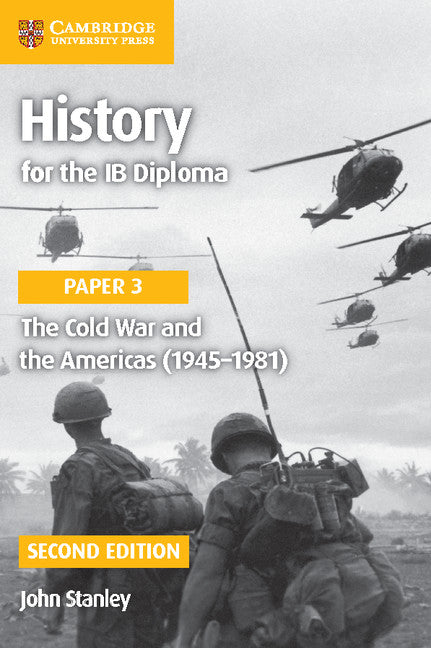
History for the IB Diploma Paper 3: The Cold War and the Americas (1945–1981)
- Sale price
- Rs. 2,520.00
- Regular price
-
Rs. 3,050.00 - Regular price
- Rs. 2,520.00
- Unit price
- per
(MRP is inclusive of all taxes)
Guaranteed safe checkout
Couldn't load pickup availability
Details
Details
This History for the IB Diploma Paper 3 The Cold War and the Americas (1945-81) (second edition) coursebook Cambridge Elevate edition covers Paper 3, HL option 2: History of the Americas, Topic 16: The Cold War and the Americas (1945-1981) of the History for the International Baccalaureate (IB) Diploma syllabus for first assessment in 2017. Tailored to the requirements of the IB syllabus, and written by an experienced examiner and teacher it offers an authoritative and engaging guidance through the development of the Cold War and the impact it had on the Americas. This History for the IB Diploma Paper 3 coursebook Cambridge Elevate edition offers activities throughout the chapters to encourage an exploratory and inquiring approach to historical learning, a wide range of primary and secondary sources to inspire engagement with multiple historical perspectives and interpretations, and develop students’ analytical skills. It also offers links to Theory of Knowledge to stimulate reflective discussion and Paper 3 exam-style questions to help improve student performance and provide preparation for assessment.
Features
- Authoritative and comprehensive text, written by experienced IB History examiners, covering one topic per title, to help students adopt an investigative and thorough approach to their study.
- Activities throughout the chapters to encourage an exploratory and inquiring approach to historical learning.
- A wide range of primary and secondary sources to develop students’ analytical skills.
- Opportunities for balanced historical debate to inspire engagement with multiple historical perspectives and interpretations.
- Links to Theory of Knowledge concepts to stimulate reflective discussion.
- Key Concept links to highlight how the 6 new key concepts can be integrated into the course.
- Paper 3 exam-style questions to help improve student performance and provide preparation for assessment.
Contents
- 1. Introduction
- Chapter 2. The US and the Cold War 1945–61, with case-studies of Cuba and Chile:
- 2.1. How are the government and political system in the US structured?
- 2.2. What were the implications for the US and the Americas of Truman's response to the emerging Cold War from 1945 to 1950?
- 2.3. What was the effect of US participation in the Korean War, 1950–53?
- 2.4. How far did 'New Look' under Eisenhower and Dulles change US–Soviet relations?
- 2.5. What was the US's response to Cold War developments in the Americas?
- 2.6. Case Study: Cuba 1945–59: Why were relations between Cuba and the US historically important?
- 2.7. Case Study: Cuba 1945–59: Why was there a revolution against Batista?
- 2.8. Case Study: Chile 1945–64: How did the early years of the Cold War affect Chile?
- 2.9. Case Study: Chile 1945–64: To what extent did the US influence Chilean politics 1952–64?
- Chapter 3. The US and the Cold War 1961–81, with case-studies of Cuba and Chile:
- 3.1. How did Kennedy define US foreign policy from 1961 to 1963?
- 3.2. Why did the Vietnam War have such a profound effect on the US and in the Americas?
- 3.3. How did US foreign policy change under Nixon in the 1970s?
- 3.4. Why was Jimmy Carter an 'outsider' in foreign policy 1977–81?
- 3.5. What were the implications of US foreign policy for the Americas between 1961 and 1981?
- 3.6. How did the Cold War further influence domestic policy in the US between 1961 and 1981?
- 3.7. Case Study: Cuba 1959–81: What impact did the Cuban Revolution have on the Cold War?
- 3.8. Case Study: Cuba 1959–81: Did the Cold War influence Castro's domestic policy?
- 3.9. Case Study: Chile 1964–81: How did the left come to power in Chile?
- 3.10. Case Study: Chile 1964–81: What was the impact of the Pinochet regime after 1973?
- Chapter 4. Canada and the Cold War 1945–63: 4.1. How are the government and political system in Canada structured?
- 4.2. What were the long-term implications of the Cold War on foreign policy in Canada between 1945 and 1963?
- 4.3. To what extent did the Cold War influence different areas of Canadian domestic policy?
- Chapter 5. Canada and the Cold War 1964–81:
- 5.1. What were the long-term implications of the Cold War on foreign policy in Canada between 1964 and 1981?
- 5.2. How did the Cold War in the 1960s and 1970s influence different areas of Canadian domestic policy?
- 5.3. Did the Cold War change Canada?
- Chapter 6. Exam practice
- Further Reading
- Index.
Accessibility
- Unknown accessibility: The accessibility information of this publication is unknown.
Notified by email when this product becomes available
