

-
 Media gallery

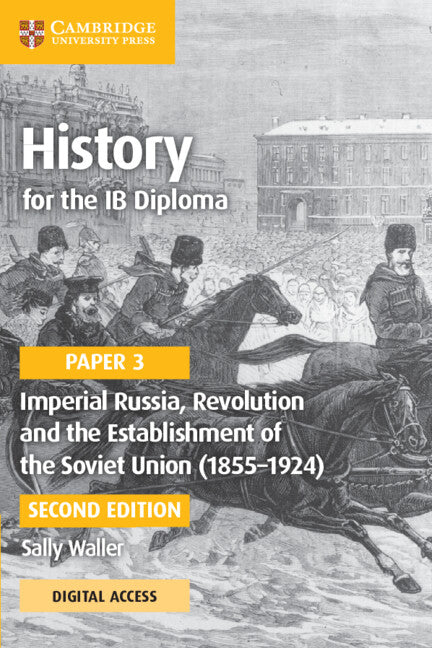
History for the IB Diploma Paper 3: Imperial Russia, Revolution and the Establishment of the Soviet Union (1855–1924)
- Sale price
- Rs. 2,640.00
- Regular price
-
Rs. 3,050.00 - Regular price
- Rs. 2,640.00
- Unit price
- per
(MRP is inclusive of all taxes)
Comprehensive books to support study of History for the IB Diploma Paper 3, revised for first assessment in 2017.
Guaranteed safe checkout
Couldn't load pickup availability
Details
Details
This History IB Diploma Paper 3 Imperial Russia, Revolution and the Establishment of the Soviet Union (1855-1924) (second edition) coursebook Cambridge Elevate edition covers Paper 3, HL option 4: History of Europe, Topic 12: Imperial Russia, Revolution and the Establishment of the Soviet Union (1855-1924) of the History for the International Baccalaureate (IB) Diploma syllabus for first assessment in 2017. Tailored to the requirements of the IB syllabus, and written by an experienced examiner and teacher it offers authoritative and engaging guidance through the tsarist autocracy in Russia, the revolutions of 1917, the Civil War and Lenin’s rule. This History for the IB Diploma Paper 3 coursebook Cambridge Elevate edition offers activities throughout the chapters to encourage an exploratory and inquiring approach to historical learning, a wide range of primary and secondary sources to inspire engagement with multiple historical perspectives and interpretations, and develop students’ analytical skills. It also offers links to Theory of Knowledge to stimulate reflective discussion and Paper 3 exam-style questions to help improve student performance and provide preparation for assessment.
Features
- Authoritative and comprehensive text, written by experienced IB History examiners, covering one topic per title, to help students adopt an investigative and thorough approach to their study.
- Activities throughout the chapters to encourage an exploratory and inquiring approach to historical learning.
- A wide range of primary and secondary sources to develop students’ analytical skills.
- Opportunities for balanced historical debate to inspire engagement with multiple historical perspectives and interpretations.
- Links to Theory of Knowledge concepts to stimulate reflective discussion.
- Key Concept links to highlight how the 6 new key concepts can be integrated into the course.
- Paper 3 exam-style questions to help improve student performance and provide preparation for assessment.
Contents
- Chapter 1. Introduction
- Chapter 2. Alexander II reform and the emancipation of the serfs 1855–61:
- 2.1. Why is Alexander II associated with the 'modernisation' of Russia?
- 2.2. Why did modernization demand the emancipation of the serfs?
- 2.3. How was emancipation carried out and how did this change Russia?
- Chapter 3. Alexander II's subsequent reforms and their impact 1861–81:
- 3.1. How, and with what success, did the regime address the need for further modernisation in the empire?
- 3.2. Was there a conservative reaction in the later years of Alexander II's rule?
- Chapter 4. Alexander III (1881-1894) and Nicholas II (1894-1917): modernisation, repression and the growth of opposition to 1904: 4.1. What was the nature of tsardom under Alexander III and Nicholas II?
- 4.2. What attempts were made at modernisation?
- 4.3. Why and how did opposition movements grow?
- Chapter 5. The 1905 revolution and its aftermath:
- 5.1. What was the significance of the Russo–Japanese War?
- 5.2. What brought about the 1905 revolution?
- 5.3. How successful was Stolypin in bringing about change in Russia from 1906?
- 5.4. What was Russia like in 1914?
- Chapter 6. The impact of War and the revolutions of 1917:
- 6.1. What was the impact of the First World War on Russia?
- 6.2. Why did revolution break out in February 1917?
- 6.3. Why were the Provisional Government and Dual Power overthrown in October 1917?
- 6.4. What roles did Lenin and Trotsky play in the events of 1917?
- Chapter 7. Lenin's Russia 1917–24:
- 7.1. How did the Bolsheviks consolidate power and win the Russian Civil War?
- 7.2. Why was War Communism introduced in 1918 and replaced by the NEP in 1921?
- 7.3. To what extent did the new Soviet state rely on terror and coercion?
- 7.4. What was the relationship between Bolshevik Russia and the rest of the world?
- Chapter 8. Exam practice
- Further Reading
- Index.
Accessibility
Digital Coursebook (2 Years) (for pack)- Unknown accessibility: The accessibility information of this publication is unknown.
Notified by email when this product becomes available
